
On the southwest corner of the Syracuse University Quad, the Physics Building and Hendricks Chapel stand almost next door to each other. It might seem an unlikely pair to share a sidewalk. A house of worship and a house of science. Inside the Physics Building is Syracuse’s gravitational wave research group. Syracuse had the first Laser Interferometer Gravitational Observatory (LIGO) research group in the country, and its physicists played a leading role in confirming the presence of gravitational waves (which Einstein had predicted nearly a century before). Next door, students of all faiths have ventured into Hendricks to reach for something they can’t measure at all. Both of these examples exhibit the very same human impulse of reaching towards something vast and unseen.
This same dichotomy is currently hanging on the wall in the James F. White Gallery at the Syracuse University Art Museum, Space and the Sacred: Letterio Calapai’s Prints traces one artist’s struggle to make sense of a century of relentless technological and social change. Curated by Julia Neufeld G’23, G’24, the exhibition gathers 21 prints by Calapai exploring two themes seemingly at odds: religion and space exploration.
Calapai was born in Boston in 1901 and built his career in New York, with commissions for the Federal Art Project through the 1930s and 1940s and, later, founding the printmaking department at the University of Buffalo. He’s most well-known for his work in American Realism. But the prints on view this fall move past realism and explore more abstract concepts. Awe and wonder. The vast and unseen.
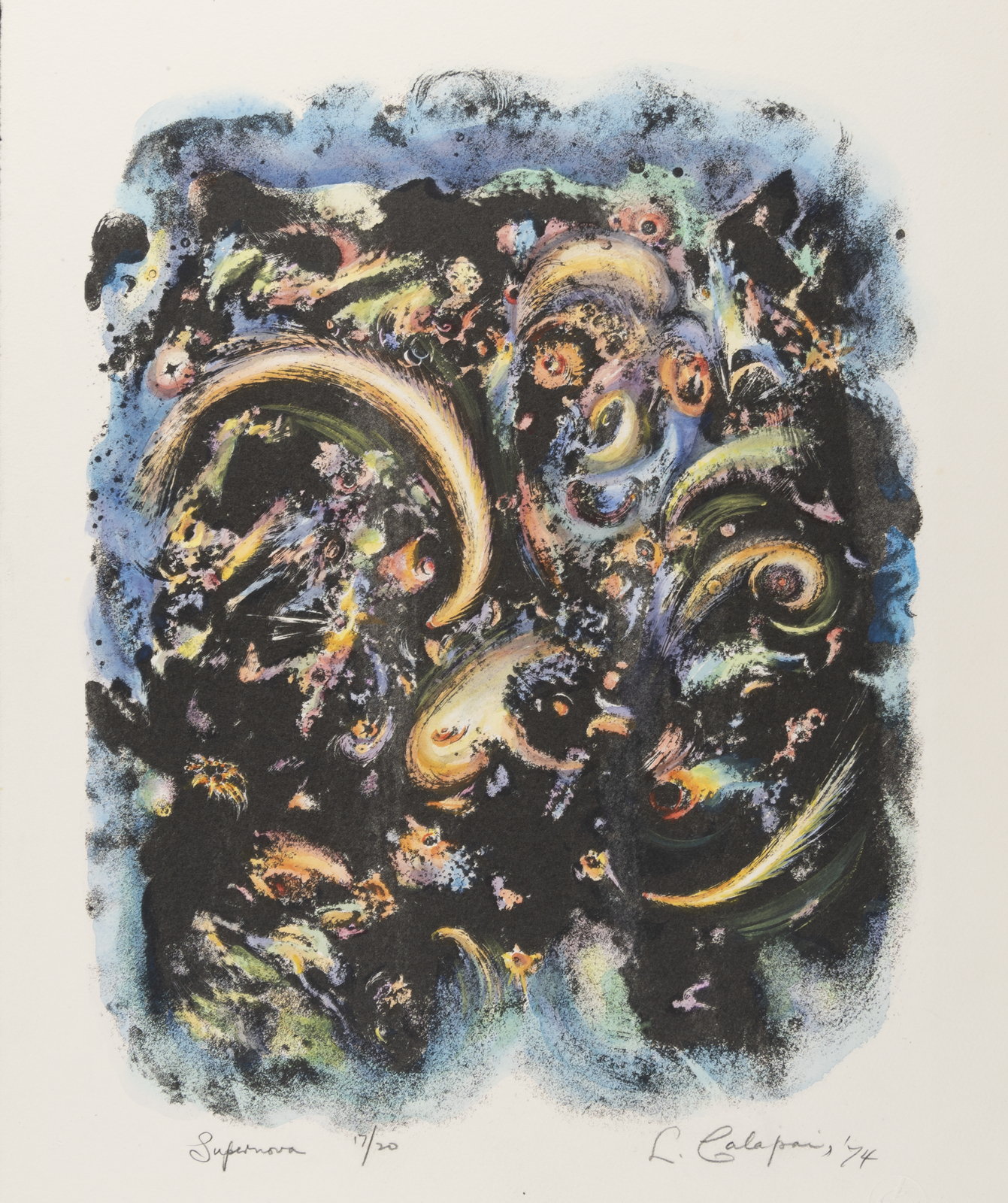
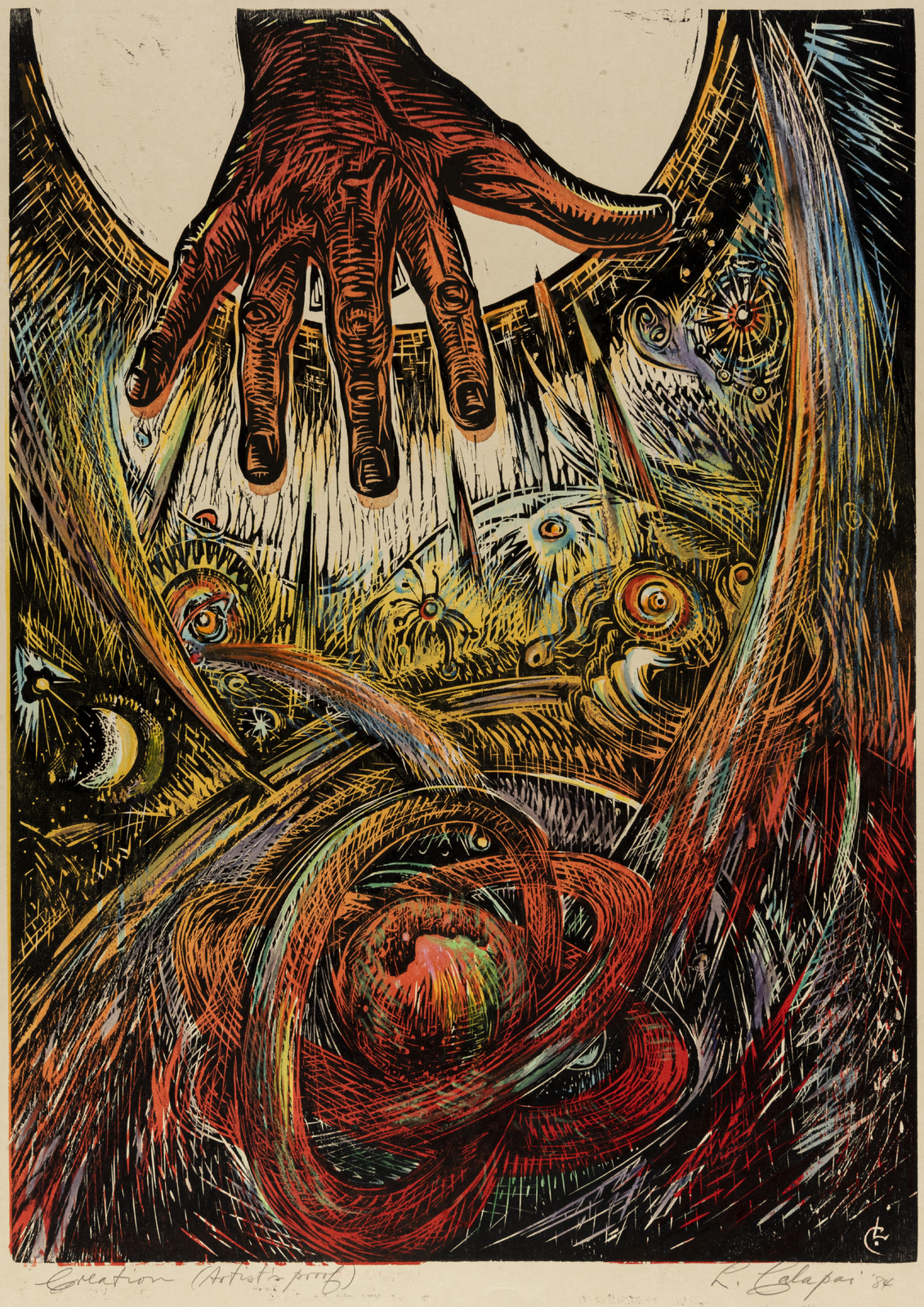
This is not strictly an abstract show. Nuns, astronauts, planets, galaxies, atoms all represented in these works. But Calapai keeps nudging you past the everyday. Creation, sets a commanding hand over the Earth, the planet ringed by spinning electrons borrowed from an early diagram of the atom. It is a strange, telling collision, the oldest image we have for divine authority laid over the newest image of the era for matter itself. Set beside Calapai’s Supernova, Creation reads less like a statement of faith than a record of one man trying to hold a fast-changing century in his head all at once.
After seeing Space and the Sacred, walk back out onto the Quad where Hendricks Chapel and the Physics Building stand. What seemed an odd pairing at first might now make complete sense. For millenia, humans have been trying to make sense of the universe in any way they knew how. Calapai spent nearly fifty years on that same exact beat and this exhibition puts you right in the middle of the conversation.
By Taylor Westerlund, Communications and Outreach Specialist